Web Design
E MİLLİ LİQA
The Official Esports League Platform for Azerbaijani Football Clubs
Year :
2020
Industry :
Esport / Sport-Tech
Client :
E Milli Liqa
Project Duration :
2-3 month
Problem :
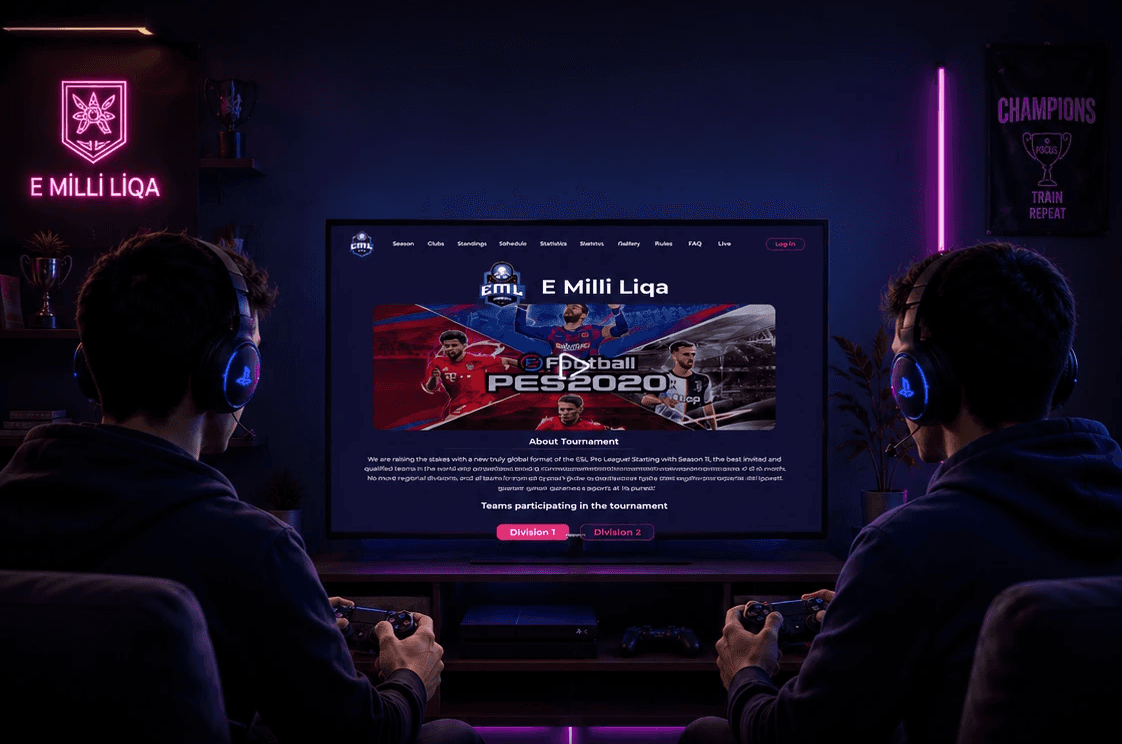
There was no official, structured platform in Azerbaijan for following competition between clubs in the esports space. Each club had its own representatives (users) competing in a league format, but there was no centralized system for presenting the process in a transparent and trackable way.
The platform had to handle multiple layers of data — teams, players, points, groups, and playoff stages — while presenting this information clearly without overwhelming the user. Making complex data easy to understand and navigate was the main challenge.

Solution :
I designed the platform as a public monitoring hub — both club representatives and spectators could follow results through the same interface, while administrators managed registration and league operations in the background.
I approached the experience through several key principles:
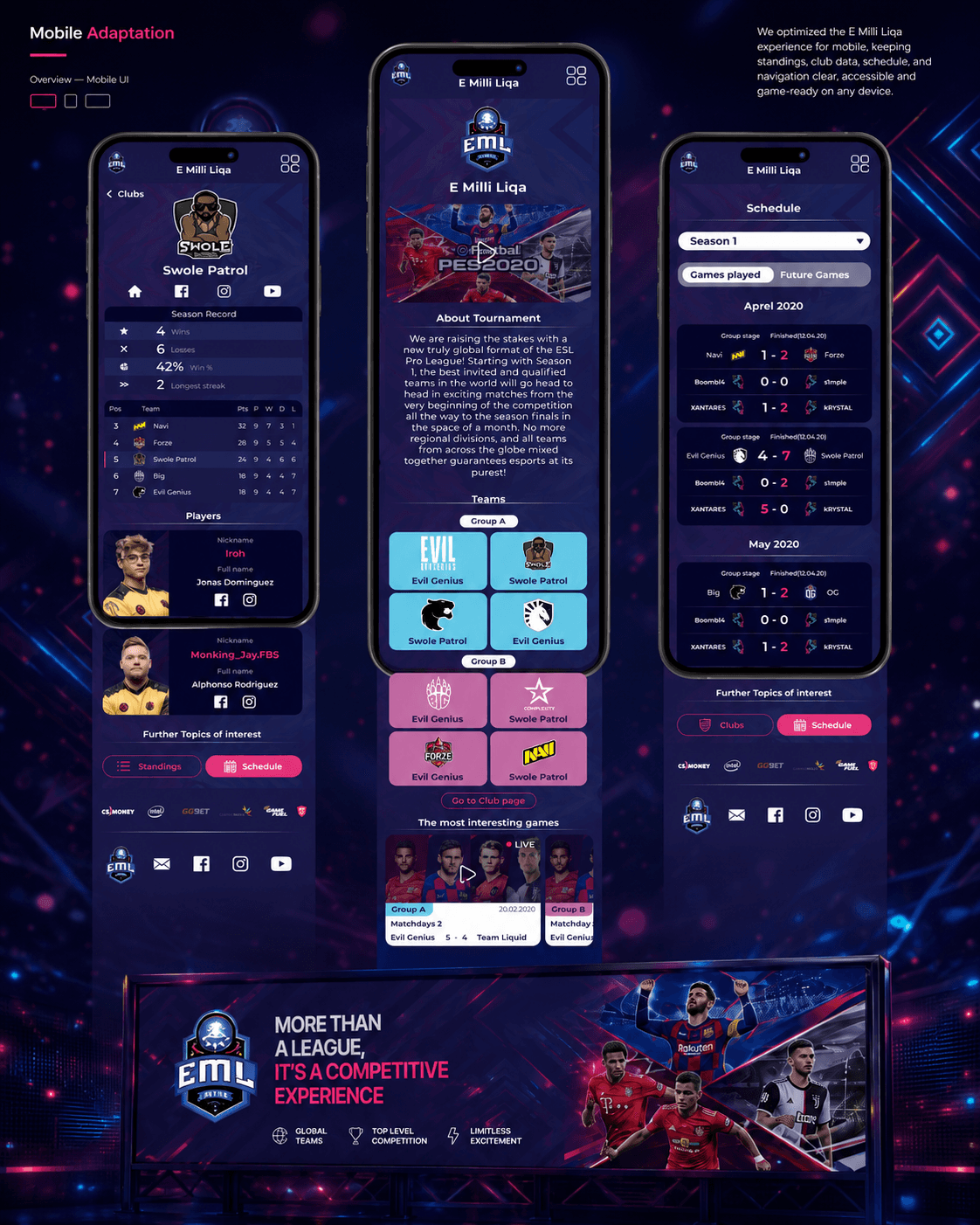
Layered navigation — users first see the overall picture (Standings, Clubs) and can then drill down into specific details, such as an individual team or player.
Filtering system — users can filter by Group A/B, Season, or Club to focus only on the data relevant to them.
Visual hierarchy — tables use color coding to highlight the user's own team, while clear typographic hierarchy makes numerical data easy to scan.
Multilingual structure (AZ/EN) — designed to accommodate the participation of international teams such as NAVI, FORZE, and others.
The visual language was designed specifically for the esports audience: a dark navy/purple background combined with neon-pink accents, geometric diamond patterns to create a sense of energy and competition, and bold typography to maintain readability.
Challenge :
The biggest challenge was simplifying complex data — including standings, statistics, and playoff brackets — while keeping the experience equally understandable for two different audiences: club representatives and casual spectators.
There was a significant amount of information to present, but the interface could not feel overloaded. I solved this through a modular structure and progressively revealed information, allowing users to move naturally from overview → detail.

Summary :
"E Milli Liqa" launched as Azerbaijan's first official esports league platform and was put into real-world use.
Clubs were able to track their results, while spectators gained access to a transparent statistics and tournament monitoring center. I led the project independently from research through to the final UI screens, demonstrating my ability to transform complex data structures into a simple, accessible, and engaging digital experience.
More Projects




Web Design
E MİLLİ LİQA
The Official Esports League Platform for Azerbaijani Football Clubs
Year :
2020
Industry :
Esport / Sport-Tech
Client :
E Milli Liqa
Project Duration :
2-3 month
Problem :
There was no official, structured platform in Azerbaijan for following competition between clubs in the esports space. Each club had its own representatives (users) competing in a league format, but there was no centralized system for presenting the process in a transparent and trackable way.
The platform had to handle multiple layers of data — teams, players, points, groups, and playoff stages — while presenting this information clearly without overwhelming the user. Making complex data easy to understand and navigate was the main challenge.
Solution :
I designed the platform as a public monitoring hub — both club representatives and spectators could follow results through the same interface, while administrators managed registration and league operations in the background.
I approached the experience through several key principles:
Layered navigation — users first see the overall picture (Standings, Clubs) and can then drill down into specific details, such as an individual team or player.
Filtering system — users can filter by Group A/B, Season, or Club to focus only on the data relevant to them.
Visual hierarchy — tables use color coding to highlight the user's own team, while clear typographic hierarchy makes numerical data easy to scan.
Multilingual structure (AZ/EN) — designed to accommodate the participation of international teams such as NAVI, FORZE, and others.
The visual language was designed specifically for the esports audience: a dark navy/purple background combined with neon-pink accents, geometric diamond patterns to create a sense of energy and competition, and bold typography to maintain readability.
Challenge :
The biggest challenge was simplifying complex data — including standings, statistics, and playoff brackets — while keeping the experience equally understandable for two different audiences: club representatives and casual spectators.
There was a significant amount of information to present, but the interface could not feel overloaded. I solved this through a modular structure and progressively revealed information, allowing users to move naturally from overview → detail.
Summary :
"E Milli Liqa" launched as Azerbaijan's first official esports league platform and was put into real-world use.
Clubs were able to track their results, while spectators gained access to a transparent statistics and tournament monitoring center. I led the project independently from research through to the final UI screens, demonstrating my ability to transform complex data structures into a simple, accessible, and engaging digital experience.
More Projects
Web Design
E MİLLİ LİQA
The Official Esports League Platform for Azerbaijani Football Clubs
Year :
2020
Industry :
Esport / Sport-Tech
Client :
E Milli Liqa
Project Duration :
2-3 month
Problem :
There was no official, structured platform in Azerbaijan for following competition between clubs in the esports space. Each club had its own representatives (users) competing in a league format, but there was no centralized system for presenting the process in a transparent and trackable way.
The platform had to handle multiple layers of data — teams, players, points, groups, and playoff stages — while presenting this information clearly without overwhelming the user. Making complex data easy to understand and navigate was the main challenge.
Solution :
I designed the platform as a public monitoring hub — both club representatives and spectators could follow results through the same interface, while administrators managed registration and league operations in the background.
I approached the experience through several key principles:
Layered navigation — users first see the overall picture (Standings, Clubs) and can then drill down into specific details, such as an individual team or player.
Filtering system — users can filter by Group A/B, Season, or Club to focus only on the data relevant to them.
Visual hierarchy — tables use color coding to highlight the user's own team, while clear typographic hierarchy makes numerical data easy to scan.
Multilingual structure (AZ/EN) — designed to accommodate the participation of international teams such as NAVI, FORZE, and others.
The visual language was designed specifically for the esports audience: a dark navy/purple background combined with neon-pink accents, geometric diamond patterns to create a sense of energy and competition, and bold typography to maintain readability.
Challenge :
The biggest challenge was simplifying complex data — including standings, statistics, and playoff brackets — while keeping the experience equally understandable for two different audiences: club representatives and casual spectators.
There was a significant amount of information to present, but the interface could not feel overloaded. I solved this through a modular structure and progressively revealed information, allowing users to move naturally from overview → detail.
Summary :
"E Milli Liqa" launched as Azerbaijan's first official esports league platform and was put into real-world use.
Clubs were able to track their results, while spectators gained access to a transparent statistics and tournament monitoring center. I led the project independently from research through to the final UI screens, demonstrating my ability to transform complex data structures into a simple, accessible, and engaging digital experience.